Key Takeaway
- Age 4 is a major social turning point, children move from parallel play to cooperative play.
- During the preschool years (roughly 3–5), executive functions like self-control and “pause before acting” strengthen alongside ongoing prefrontal-cortex maturation.
- Theory of Mind begins to form, children realise others have different thoughts and feelings.
- Social readiness is a stronger predictor of Year 1 success than early academic drilling.
- Parents can strengthen social skills at home through guided storytelling, mixed-age play, and collaborative activities.
At age four, children shift from playing beside others to playing with them because key brain areas responsible for empathy, impulse control, and perspective-taking rapidly develop. This stage, often called a social “golden window,” lays the foundation for cooperation and communication.
So if your child seems to hug their stuffed toy protectively at one moment but shares them with a sibling or a friend the next, that shift is perfectly normal!
So, let our Kindergarten explain to you why 4 years old is the golden age for social skills.
The Science Behind a 4-Year-Old Brain
The Prefrontal Cortex
Around age four, the brain’s prefrontal cortex becomes much more active. This is the part of the brain linked to:
- Planning
- Impulse control
- Emotional regulation
- Understanding social rules
In simple terms, this means children start getting better at pausing before reacting, waiting for a turn, and noticing that their behaviour affects others.
Kids are still very much learning of course, but this stage marks the beginning of more intentional social behaviour.
“This is also why four-year-olds often seem caught between two worlds. One moment they may insist everything must go their way. Next moment, they may show surprising kindness, compromise, or awareness of another child’s feelings.”
Theory of Mind
One of the biggest developmental shifts at this age is something called Theory of Mind. This refers to a child’s growing understanding that other people have their own thoughts, feelings, beliefs, and perspectives.
Before this ability strengthens, a child may assume everyone thinks exactly the way they do. As it develops, they begin to understand things like:
- Someone else may feel sad even if they are happy
- A friend may want a different toy
- Another child may not know what they know
- People can misunderstand, disagree, or need comfort
This is one of the earliest building blocks of empathy. It is also what makes more complex social play possible.
Why age 4 specifically: Age three is important too, but many children are still more focused on their own immediate wants and emotions. By age five, many children are more socially capable already, but the major transition is usually already underway. In other words, age four often sits right in the sweet spot, where children are developmentally ready to stretch into deeper social learning.
Social Milestones Every Malaysian Parent Should Watch For
For many parents, you might see signs of subtle shifts in how your child acts. So, let’s look at some of them.
From Parallel to Cooperative Play
One of the clearest signs of social development at age four is the move from parallel play to cooperative play.
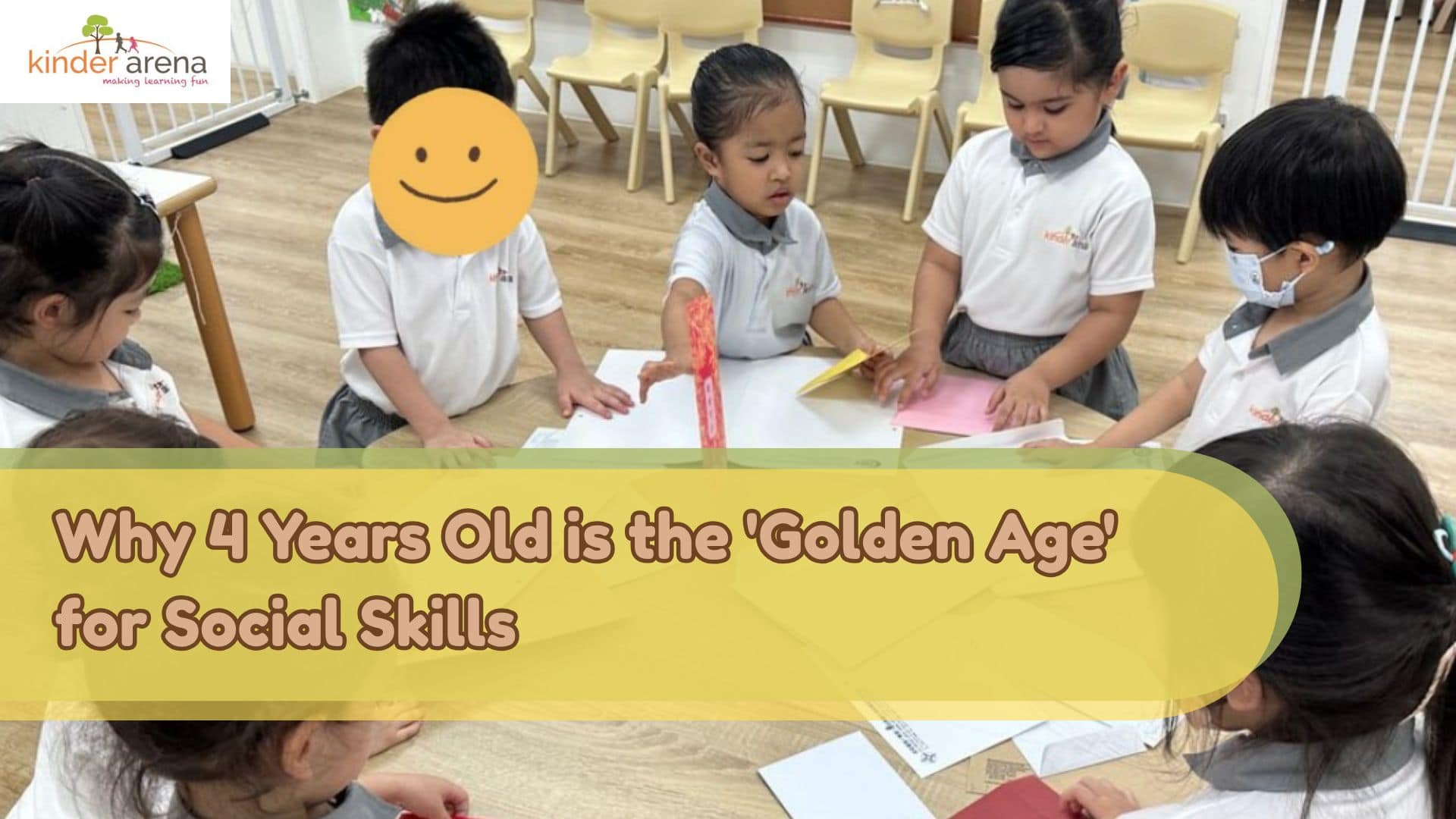
Instead of just sitting beside another child with separate toys, children begin building something together, acting out shared roles, or creating pretend scenarios as a group. This is sometimes called sociodramatic play, and it is incredibly valuable.
You may hear things like:
- “You be the doctor, I’ll be the patient.”
- “Let’s make this a restaurant.”
- “I’m the pilot, you’re the passenger.”
These moments are more than cute! They show a child learning to collaborate, assign roles, follow shared rules, and imagine another person’s perspective.
Emerging Empathy
At this age, children may begin showing empathy more naturally, not just because an adult told them to.
For example, a child might offer a toy to a crying friend, pat someone gently, or say, “It’s okay, don’t be sad.”
That response may still be simple, but it matters. It shows they are starting to connect emotionally with other people’s experiences.
Conflict Resolution
Conflict is normal in early childhood, and it is not always something to fear. In fact, small conflicts can be very useful learning opportunities.
A growing four-year-old may begin to:
- Understand whose turn it is
- Recognise that games have rules
- Accept simple compromises
- Recover more easily after disappointment
They still need adult support, but some children start resolving minor issues with less intervention. That is a positive sign.
Linguistic Socialising
Social growth and language growth often move together. Around this age, many children begin using longer sentences, often around five to six words or more, to express themselves during play.
This matters because language gives children tools for social connection. They start using words to negotiate, explain, persuade, include, and problem-solve.
Examples might include:
- “Can I use that after you?”
- “Let’s build the house here.”
- “No, this one is for the baby.”
- “You go first, then me.”
These are powerful signs that a child is not only speaking more, but socialising through language.
How Malaysia’s KP2026 Curriculum Supports Your 4-Year-Old
The Six Core Domains
Malaysia’s early childhood direction under KP2026 places strong emphasis on whole-child development, not just early academics. This is important because school readiness involves more than knowing letters and numbers.
Two especially important pillars for four-year-olds are:
- Socio-emotional development
- Citizenship and values
These areas help children learn how to understand feelings, behave respectfully, cooperate with others, and function as part of a group.
Play-Based Learning Is Not “Just Playing”
To adults, free play can sometimes look casual or wasted time. In truth, it is one of the richest forms of social learning a child can have.
In a quality kindergarten setting, play becomes a social lab where children practise:
- Sharing space
- Taking turns
- Reading facial expressions
- Solving disagreements
- Communicating ideas
- Following group routines
This is one reason many modern early years programmes place such a strong focus on guided play and discovery-based learning.
Cultural Intelligence in Malaysia
Malaysia gives children a unique social environment because they often grow up in multicultural, multilingual spaces.
A well-designed preschool setting can help children learn how to move comfortably across different social contexts.
This may include:
- Greeting respectfully
- Learning classroom manners
- Engaging with children from different language backgrounds
- Understanding routines shaped by local values and community norms
These early experiences help children become more respectful and socially aware.
Peer-to-Peer Communication
One of the most powerful things about kindergarten is that children do not only learn from adults. They learn constantly from other children.
Sometimes a peer can model a behaviour in a way that feels more natural and less pressured than direct adult correction.
“A child may listen more closely when they see another child waiting patiently, using polite words, or joining a group successfully.”
This “mirror effect” matters because children often learn social boundaries best by observing, copying, and responding to one another.
Social Competence vs Academic Drilling
Many parents worry about whether their child is learning enough academically. That concern is understandable.
However, at age four, social competence often matters more than early drilling.
A child who can:
- Sit with a group
- Follow instructions
- Express needs clearly
- Regulate emotions
- Join in classroom activities
is often much better positioned for Year 1 than a child who can memorise content but struggles socially.
Academic skills can grow steadily over time but social readiness gives children the confidence and stability to learn well in the first place.
The Red Flags: When to Seek Support
Every child develops differently, and not all children hit milestones at exactly the same pace. A quieter child is not automatically struggling and a child who prefers solo play sometimes is not necessarily behind.
Still, there are certain social gaps parents may want to monitor more closely.
Possible signs that extra support may be worth exploring include:
- Limited eye contact across many situations
- Little or no interest in interacting with peers
- Difficulty following simple two-step social instructions
- Very limited pretend play
- Frequent inability to respond to name or social cues
- Extreme distress in group settings beyond what is typical adjustment
- Minimal back-and-forth communication during play
These signs do not always mean something is wrong, but it helps parents to be aware.
Today, schools and education systems in Malaysia are increasingly aware of the importance of early identification and support.
“The goal is not to label children too quickly, but to make sure they receive the right help early when needed.”
Home Play: 3 Activities to Strengthen the Golden Window
It goes without saying, but parents play a huge role in reinforcing social development.
The good news is that this does not require expensive materials or complicated routines. Many of the best activities are simple, warm, and easy to repeat.
Activity 1: The “What If” Game
This is a simple but powerful way to build empathy and perspective-taking.
Ask your child short everyday scenarios like:
- “What if your friend forgot their lunch?”
- “What if your brother feels sad?”
- “What if someone is scared to join the game?”
- “What if your friend falls down?”
Then gently ask follow-up questions:
- “How do you think they feel?”
- “What could you do?”
- “What would help?”
There is no need to turn it into a test, please do not do that. The goal is to open up thinking about other people’s feelings and responses.
Activity 2: Mixed-Age Playdates
Playing with older children can be very helpful because it introduces natural modelling.
Younger children often learn patience, flexibility, and social cues simply by being around slightly more mature peers.
Mixed-age play can support:
- Patience
- Negotiation
- Flexible communication
- Turn-taking
- Emotional adaptation
Older children often “scaffold” younger children’s behaviour in surprising ways. They show how games work, guide routines, and model problem-solving in real time.
A simple moment you might hear:
“I show you okay? We take turns. You go first, then my turn.”
Activity 3: Collaborative Art
This is a lovely activity because it combines creativity with teamwork.
Use one large piece of mahjong paper and set one shared goal, such as:
- “Let’s draw one big zoo together.”
- “Let’s make a giant house.”
- “Let’s create a whole town.”
- “Let’s draw a park for everyone.”
The point is not the final artwork, it is the process of working together.
Collaborative art helps children practise:
- Sharing space
- Planning together
- Compromising
- Respecting each other’s ideas
- Sticking with a shared goal
When parents join in, it can become especially warm and a great bonding experience. The best part? You can frame the picture up as a memory.
Why This Matters Even More Today
In a world filled with screens and growing digital distractions, social development deserves even more attention, not less.
Many parents today understandably worry about academic readiness and if their child is “keeping up” in an increasing competitive world.
But in the age of the internet and let’s be frank here, outsourced AI thinking, strong human skills matter more than ever.
Children need the:
- Right environment
- Warm guidance
- Meaningful peer interaction
- Room to explore
At Kinder Arena, we believe children learn best through inquiry-based learning and hands-on experiences that make social growth feel natural and joyful.
Through collaborative play and working on projects together, we help children strengthen the confidence and communication they need for the world they are growing into.
If you’re interested in how we help your little ones to develop their social skills that support them far beyond kindergarten.
Why not give us a call and enquire about our programme or teaching methods? We are happy to answer.
Source:
- HSE (Ireland Health Service Executive) — “Stages of play” (page undated)
Supports: the typical progression from parallel → associative (3–5) → cooperative (4–6) - American Academy of Pediatrics (AAP) — “Early Childhood Development” module (Feb 1, 2023)
Supports: developmental milestones including social play references (parallel play appears in AAP milestone material). - PNAS (Tomasello et al.) — “How children come to understand false beliefs” (2018)
Supports: classic finding that false-belief understanding emerges around 4–5 years. - Wiley (Child Development Perspectives) — “How Does Children’s Theory of Mind Become Explicit?” (Sodian, 2020)
Supports: around age 4 children begin to explicitly understand beliefs can differ from reality. - Malaysia national news: The Star — “New preschool curriculum to focus on six learning areas…” (Jan 5, 2026)
Supports: same six KP2026 learning areas and emphasis on holistic development. - Mayo Clinic — “Screen time and children: How to guide your child” (Jun 19, 2024)
Supports: widely cited AAP-aligned guidance (e.g., 1 hour/day of high-quality programming for ages 2–5, co-viewing encouraged).
Frequently Asked Questions About Golden Age Social Skills
Why Does My 4-Year-Old Suddenly Want To Play With Other Children?
This is often a healthy sign of development. Around age four, many children become more interested in shared imagination, group play, and forming friendships because their social understanding is expanding quickly.
Is It Normal If My Child Still Prefers Playing Alone Sometimes?
Yes, absolutely. Even socially healthy children still need solo play. What matters more is whether your child can also show interest in others, respond socially, and join shared activities sometimes.
Is Social Development More Important Than Academics At Age 4?
At this stage, social development is often the stronger foundation. A child who can cooperate, listen, communicate, and regulate emotions is usually better prepared for later academic learning than one who has only been drilled on content.
How Does KP2026 Affect My Child’s Preschool Experience?
KP2026 supports a more balanced approach to early childhood education by recognising that children need socio-emotional growth, communication skills, and values development alongside early literacy and numeracy.
What Are Signs I Should Seek Professional Advice?
You may want to seek advice if your child consistently avoids social interaction, shows very limited eye contact, has difficulty responding to simple social cues, or does not seem interested in peer engagement over time.
How Can I Support My 4-Year-Old’s Social Skills At Home?
You can help through everyday play and conversation. Storytelling, pretend play, mixed-age interaction, collaborative art, and simple empathy-based questions are all excellent ways to strengthen social growth at home.