
Key Takeaway
- Specialized infant care focuses on the “First 1,000 Days,” prioritizing neuro-development over basic supervision.
- Licensed Taskas must adhere to a strict 1:3 caregiver-to-infant ratio for children under 12 months.
- Demand for infant spots is highest near major employment hubs, often requiring 6-month waitlists.
- Safety is regulated under Act 308 (JKM), ensuring fire safety, health department clearance, and PERMATA-certified caregivers.
Specialized infant daycare and baby nursery is a licensed, professionally managed environment designed for babies as young as two months old. It goes beyond supervision by combining regulated safety standards, certified caregivers, and neuro-development programs to support infants during the most critical stage of brain growth.
In Malaysia, many parents experience a maternity leave crunch. Under current law, most employees are entitled to a minimum of 98 days of maternity leave, which often ends before parents feel emotionally ready or have secured infant care that they truly trust. Career plans, financial commitments, and newborn needs all collide in the same short window.
Specialized infant daycare exists to bridge that tension. It offers a licensed, regulated setting where babies are not simply watched, but guided through sensory play, responsive caregiving, and medically aligned safety protocols.
For working parents today, Kinder Arena deeply understands the importance of infant care and would like to offer parents a peace of mind.
Specialized Infant Care Options
Program Type | Age Range | Monthly Fee Range ( | Staff-to-Baby Ratio | Best For |
Home-Based (Taska Di Rumah) | 2 months to 4 years | RM1,200 – RM1,800 | 1:3 (under 12 months) | Parents who prefer a smaller, home-like setting with fewer children |
Institutional / Private Infant Centre | 2 months to 3 years | RM1,800 – RM2,800 | 1:3 (under 12 months) | Working parents seeking structured routines and backup caregiver support |
Workplace Daycare | 2 months to 4 years | RM1,500 – RM2,500 (some subsidized) | 1:3 (under 12 months) | Corporate employees who want proximity to the office for easier pickups |
International / Montessori Centres | 3 months to 3 years | RM2,500 – RM4,000+ | 1:3 (under 12 months) | Families prioritizing premium facilities and early Montessori exposure |
Important Note: For babies under 12 months, licensed Taskas must comply with a 1:3 caregiver-to-infant ratio. Always verify that the ratio is maintained during your visit, not just stated in brochures.
How does Infant Care compare with a home-based Nanny / Maid?
For many Malaysian families, this is the real concern. Both domestic helpers or preschool infant daycare centres can work, so let’s go through some of the points of concern.
1. Supervision Method
Infant Care Centre
- Team-based caregiving model
- Legally required 1:3 ratio for babies under 12 months
- Backup staff available during breaks or emergencies
- Multiple adults observing feeding, sleep, and behaviour patterns
Nanny / Maid
- One adult managing all tasks
- Often responsible for cooking, cleaning, and household chores simultaneously
- No backup system if caregiver is unwell
- Supervision quality depends entirely on one individual
Why This Matters: Infants require constant visual and physical monitoring. In a centre, supervision is layered. At home, it relies on a single person’s capacity.
2. Developmental Stimulation
Infant Care Centre
- Structured sensory play sessions
- Tummy time rotation
- Language exposure routines
- Age-based floor activities
- Peer observation and early social exposure
Nanny / Maid
- No formal curriculum
- Limited knowledge of developmental milestones
- Risk of excessive cot time or passive care
- Screen exposure sometimes used to manage fussiness
Common Outcome at Home: Babies may be left in a cot, rocker, or playpen for extended periods. This can reduce floor-time exploration, which is critical for motor and brain development. Some parents notice their baby becomes harder to settle at night due to limited stimulation during the day.
3. Safety and Regulation
Infant Care Centre
- Licensed under JKM regulations
- Documented sanitization schedules
- Temperature monitoring
- Emergency SOPs in place
Nanny / Maid
- No regulatory oversight
- Safety standards depend on household setup
- No formal infection-control protocols
- Emergency handling varies by experience
Question for Parents: If something happens at 11:20am on a weekday, who is trained and accountable?
4. Social and Emotional Development
Infant Care Centre
- Early exposure to other babies
- Gradual development of parallel play
- Shared routines create predictable environments
- Trained caregivers in infant rooms
Nanny / Maid
- One-to-one attachment
- Limited peer interaction
- Less exposure to shared routines
While one-to-one care can feel reassuring, infants also benefit from observing other babies moving, babbling, and interacting. That environmental stimulation contributes to neural wiring.
“A nurturing, well-trained nanny can provide excellent care. However, that outcome depends entirely on the individual’s knowledge, energy, and supervision.”
What Does an Infant “Learn”? (The Neuro-Development Wing)
Infants do not learn through worksheets or flashcards. They learn through movement, touch, sound, and interaction.
Sensory play is the real work of infancy. In the first year, a baby’s brain forms neural connections at an extraordinary rate. Every tummy-time session, facial expression, and repeated word strengthens those pathways.
A specialized infant program is built around this science.
0 to 6 Months: Building the Foundation
At this stage, babies are wiring their sensory and motor systems.
Focus Areas
- High-contrast visual tracking
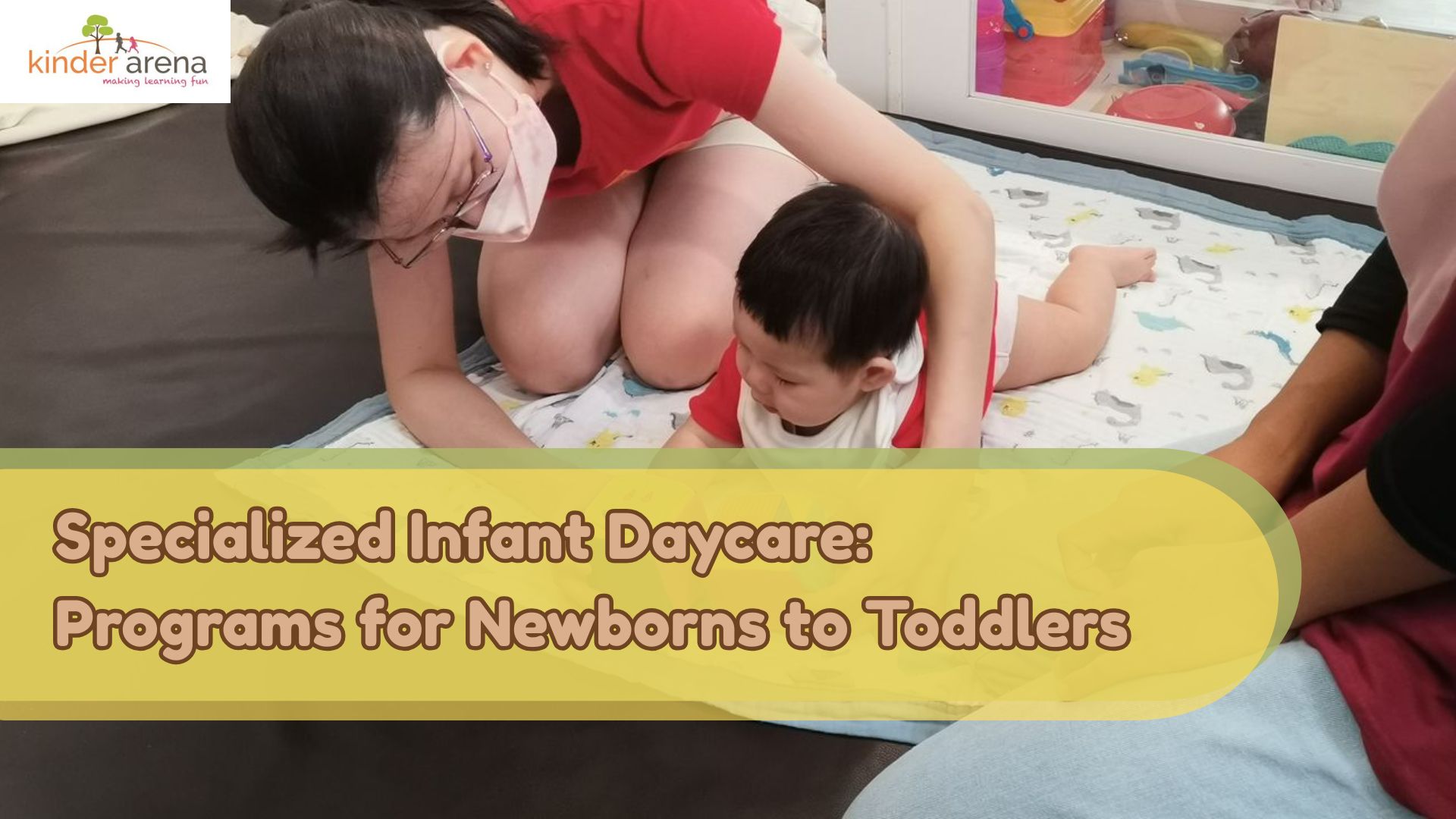
- Tummy time for neck and core strength
- Gentle texture exploration
- Face-to-face interaction and responsive cooing
Why It Matters: Tummy time builds shoulder stability for crawling, visual tracking sharpens focus and responsive interaction strengthens early language pathways.
7 to 12 Months: Exploring Cause and Effect
Curiosity increases. Babies test, drop, reach, and crawl.
Developments
- Object permanence
- Pincer grip
- Parallel play
- Increased floor mobility
Specialized programs provide safe floor environments, simple hide-and-seek games, and grasping activities that strengthen coordination and early problem-solving.
13 to 18 Months: From Movement to Meaning
Mobility becomes purposeful and sounds begin turning into words.
Focus Areas
- Language immersion through narration
- Emotional labeling
- Cruising before independent walking
- Simple social imitation
Babies absorb vocabulary long before speaking clearly. As such, consistent routines and responsive caregivers support emotional regulation and confidence.
What Are the Costs of Infant Care in 2026?
Monthly tuition is only one part of the commitment. Parents should factor in registration fees, deposits, and additional operational charges that reflect higher hygiene and staffing standards in infant rooms.
Cost Component | What It Covers | Typical 2026 Range |
Half-Day Program (Morning / Afternoon) | 4 to 5 hours of care, supervised play, basic routine support | RM1,200 – RM1,800 per month |
Full-Day Program (Standard Working Hours) | 8 to 10 hours, activities, nap schedule, meals (where applicable) | RM1,800 – RM3,000 per month |
Registration Fee | One-time enrollment processing and documentation | RM300 – RM1,000 (one-time) |
Security Deposit | Refundable deposit, usually equivalent to 1 month’s fee | 1 month tuition |
Premium Add-Ons | CCTV access, daily app updates, specialized milk storage, extended hours | RM50 – RM300 per month (depending on features) |
Disclaimer: The fees above are estimated 2026 market ranges for reference only. Please contact the respective infant care centre directly to confirm the most accurate and up-to-date fees.
Why Infant Care Costs More Than Toddler Programs
Infant rooms require:
- Lower staff-to-baby ratios (1:3 under 12 months)
- Dedicated milk preparation areas which may include refrigeration for breast milk
- Stricter sleep monitoring protocols
These operational requirements increase staffing and compliance costs.
Thus, when budgeting for 2026, it is advisable to calculate:
Monthly Fee + Add-Ons + Deposit + Registration
This gives a realistic picture of your first-year commitment.
What Makes a Program “Specialized” vs “Basic”?
When you walk into a centre, everything may look similar. Clean mats. Soft toys. Cute wall art.
But the difference is not in the décor.
- A basic program focuses on supervision.
- A specialized program treats infancy as a critical developmental stage.
Curriculum Focus: Not Just Play, But Purposeful Play
In a specialized infant room, activities are planned around how babies develop.
You may see:
- Tummy-time rotations
- High-contrast visual cards for early tracking
- Simple object permanence games
- Sensory baskets with safe textures
- Constant narration from caregivers
Frameworks like PERMATA or Montessori are adapted for babies, not as formal lessons, but as guided sensory exploration.
The goal is simple: support brain wiring during the First 1,000 Days.
High Safety Standards
Infants are more vulnerable to infections and need closer monitoring, a specialized centre accounts for this.
Look for:
- 1:3 caregiver-to-baby ratio for under 12 months
- Individual cots with spacing
- Strong ventilation
- Strict sanitization schedules
For parents, ask yourself during the visit: Does this feel systemized, or improvised?
How to Evaluate a Centre During Your Visit
It is easy to be impressed by pastel walls and cute murals. But what matters more is what happens on the floor, minute by minute. Here’s what to Look for.
1. Teacher Interaction
- Are caregivers sitting on the mat at baby level, making eye contact and speaking gently?
- Or are they standing over the babies, multitasking from a distance?
Responsive interaction builds secure attachment. Infants need face-to-face engagement, not just supervision.
2. Odor and Air Quality
- Does the room smell neutral and fresh?
- Or do you notice strong diapers or bleach odors?
A well-managed infant room should feel clean without smelling harsh. Strong chemical smells can signal overcompensation or poor ventilation.
3. Ratio Check
Count the babies and adults in the room.
For infants under 12 months, the legal ratio is 1 caregiver to 3 babies. Do not rely on what is stated in brochures. Look at what is happening during your visit.
Why Early Application Is Non-Negotiable
Infant spots are the rarest inventory in the Malaysian childcare market.
Why? Because babies under 12 months require a strict 1:3 caregiver-to-infant ratio under JKM regulations. That means centres can only admit a small number of babies per room.
Once those few slots are filled, they are gone.
The 6-month rule
A common timeline looks like this:
- Second trimester: Start researching and touring
- Third trimester: Confirm your preferred centre
- Before maternity leave ends: Finalize enrollment
Waiting until maternity leave is almost over often means limited options, higher fees, or settling for less convenient locations.
Policy Shifts Toward Universal Preschool Access
Malaysia is gradually strengthening preschool access and enrollment targets, particularly at age 5.
Building on that, the government has announced plans to make preschool education compulsory for children aged five, starting around 2027, as part of wider education reforms. The aim is that every child experiences at least one year of preschool before entering Year One at age 6.
Here is how that affects infant care:
- More parents planning childcare years in advance
- Centres managing enrollment capacity more tightly
- Limited “dropout gaps” in older classes
This creates a backfill effect:
- Infant intake is controlled because centres must plan future classroom transitions
- Fewer flexible openings mid-year
- Longer waitlists in high-demand urban areas
Conclusion: Choosing Care with Confidence
There is no perfect centre.
Every family has different routines, expectations, and comfort levels. What matters most is starting with the right foundation: licensed, regulated, and developmentally intentional care.
At Kinder Arena, we treat infant care as the beginning of lifelong learning.
We operate with:
- 1:3 teacher-to-baby ratio for under 12 months
- 1:5 ratio for 12 to 18 months
- Structured routines centered on Learning Through Play
- Purposeful tummy time, sensory exploration, and language immersion
Our infant rooms are calm, predictable environments designed to support both development and emotional security.
We also believe that infant care works best when parents remain closely connected. That is why we maintain regular communication through:
- Daily updates via Telegram
- Real-time documentation through the Little Family Room App
If you are exploring infant care in Penang, Bayan Baru, we welcome you to visit us! Observe our classrooms, and see how we support babies during the most critical stage of brain development.
Source:
- Jabatan Kebajikan Masyarakat (JKM) – FAQ on setting up and registering a Taska (includes basic ratio and approval requirements)
- Malaysia Government (MyGov) – Taman Asuhan Kanak-Kanak (TASKA) overview, Act 308 registration and age coverage
- Kursus Asuhan PERMATA (KAP) / KAAK requirement – summary in “Complete Guide to Opening a Taska in Malaysia
- Malaysia Government (MyGov) – “Rights and Benefits for Pregnant Employees” (minimum 98 days maternity leave)
- Department of Statistics Malaysia (DOSM) – “Statistics on Women Empowerment in Selected Domains, Malaysia” (female labour participation and related indicators)
- UNICEF – Early Childhood Development & First 1,000 Days (rapid brain development, importance of early experiences)
- News coverage of compulsory preschool announcement (age 5, around 2027 start) – Malay Mail, NST, RTM, SirapLimau
Frequently Asked Questions About Specialized Infant Daycare
At what age can my baby start?
Most licensed infant daycare centres in Malaysia accept babies from 2 months old (8 weeks). Enrollment typically depends on space availability and whether your baby has established a basic feeding and sleep routine.
Is it safe to send my newborn to daycare?
Licensed Taskas are regulated under the Child Care Centre Act and monitored by JKM, which sets standards for caregiver ratios, hygiene, safety procedures, and premises approval. Safety depends on compliance, trained staff, and strict adherence to infant care protocols.
What is the staff ratio for infants?
For babies under 12 months, the legally required ratio in Malaysia is 1 caregiver to 3 infants. This ensures close supervision, responsive care, and safer management of feeding, sleep, and mobility needs.
Do I need to provide the milk?
Yes. Parents typically provide expressed breast milk or formula, which must be clearly labeled and stored according to strict hygiene protocols. Licensed centres follow documented procedures for handling, warming, and tracking milk feeds.
How do I know if the Taska is licensed?
You can verify a centre’s registration through the official JKM portal or request to view their license certificate during your visit. A licensed centre should openly display its registration details and operating approval.
What happens if my baby gets a fever at school?
Centres follow health and isolation procedures, which usually include separating the child from others, monitoring temperature, and notifying parents immediately for pickup. Clear SOPs help reduce infection spread and ensure prompt medical attention when necessary.