Key Takeaway
- The “Best” Choice: Why the “perfect” school is the one that matches your child’s temperament.
- Philosophical Breakdown: Comparing the structure of Montessori vs. the social fluidity of Reggio Emilia.
- The Traditional Gap: Why rote-learning models are struggling to support KP2026’s emphasis on Higher Order Thinking Skills (KBAT).
- Structure Still Matters: Strong literacy, numeracy, and routine-building remain essential for a confident transition into Malaysia’s increasingly structured Year 1 environment.
- KA’s Inquiry-Based Advantage: How blending these worlds creates a “Future-Ready” Malaysian student.
Choosing a preschool in Malaysia is no longer just about location and fees. In 2026, parents are navigating a complex “Alphabet Soup” of philosophies.
With the National Preschool Curriculum (KP2026) shifting toward higher-order thinking, labels like “Montessori-inspired” or “Reggio-aligned” are everywhere.
But what actually happens when your child walks through the door? Today, we break down the three most common models and introduce the Kinder Arena’s Inquiry-Based approach that is setting a new standard for primary school readiness.
1. The Montessori Model
Core Philosophy: “Help Me To Do It By Myself”
Montessori education is built around independence. Children are encouraged to choose their own tasks during structured “work cycles,” building self-discipline and focus through repetition and mastery.
The emphasis is not on rushing through topics, but on deeply understanding one skill before moving to the next.
The Environment
Montessori classrooms are orderly, quiet, and minimalist. Materials are carefully arranged on low shelves, every object has a specific place and a specific “correct” use.
Many tools are self-correcting materials, meaning the child can independently see and fix mistakes without adult intervention.
Features
- Vertical Grouping: Children aged 3 to 6 share the same classroom while older students naturally mentor younger peers.
- Uninterrupted Work Cycles: Three-hour blocks allow deep concentration on a single task, such as building the Pink Tower or working with math beads.
- Practical Life Skills: Activities like pouring water, buttoning, and sweeping are core components of early development.
Benefits And Considerations
Strengths:
- Builds strong concentration and independence.
- Develops self-regulation and intrinsic motivation.
- Encourages orderly thinking and personal responsibility.
Considerations:
- Collaboration can be less frequent compared to other models.
- Structured independence can feel rigid in practice, with less emphasis on social skills
- Some children may prefer more dynamic group interaction.
Ideal for: Montessori works particularly well for children who enjoy routine, structure, and focused individual work.
2. The Reggio Emilia Approach
Core Philosophy: “The Child Has One Hundred Languages”
The Reggio Emilia approach views children as capable thinkers who express ideas in many forms: art, music, construction, storytelling, and dramatic play.
Rather than delivering fixed lesson plans, teachers co-construct learning journeys with students.
The Environment As The “Third Teacher”
Reggio classrooms are light-filled, organic, and constantly evolving. Walls are covered with documentation, including photos, drawings, and transcripts of children’s conversations.
The classroom is designed to inspire curiosity.
Features
- Emergent Curriculum: If a child discovers a spider outdoors, the next two weeks might evolve into a “Spider Project” exploring habitats, webs, and insects.
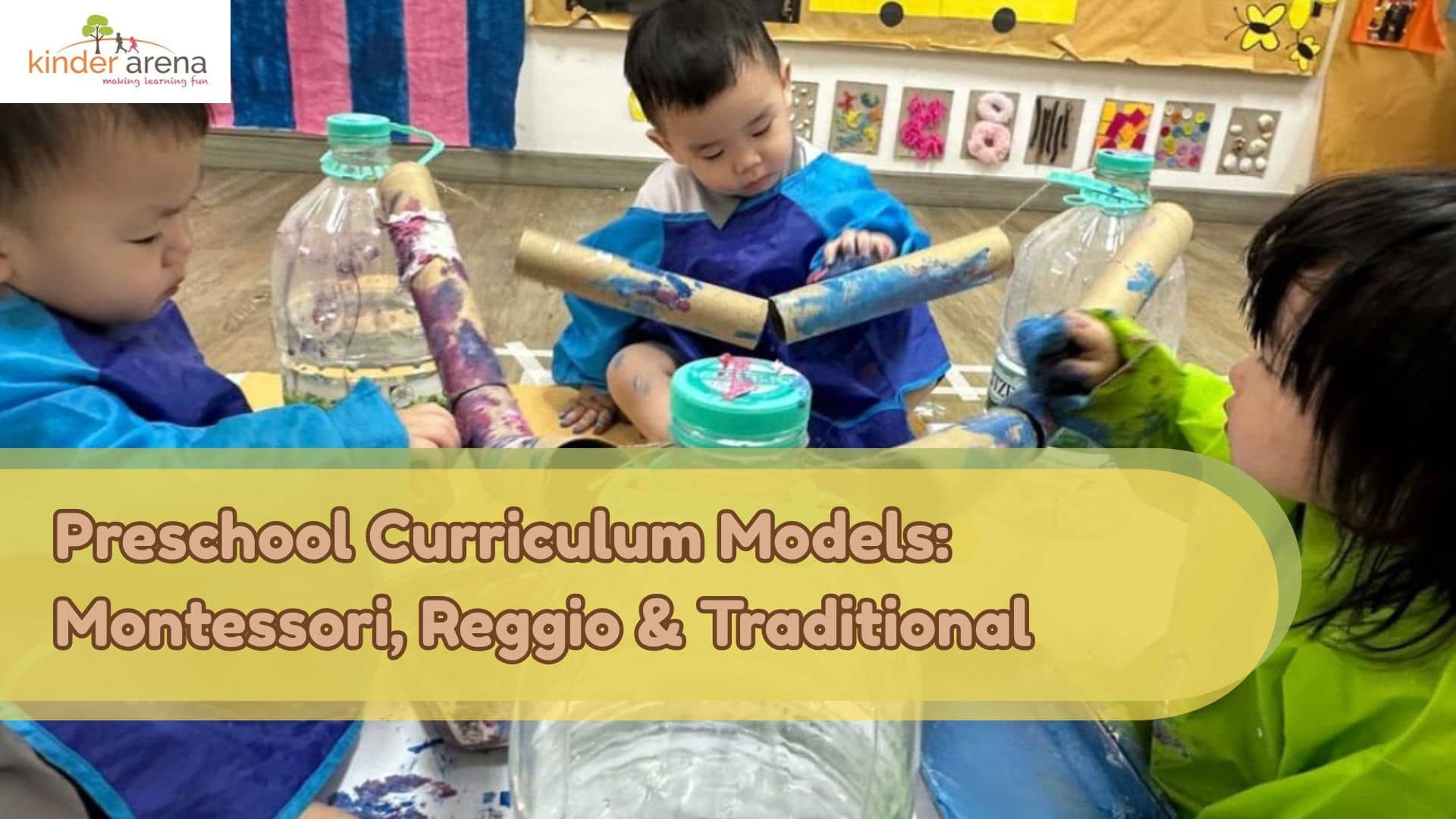
- The Atelier (Studio): A dedicated creative space for painting, clay modelling, and sensory experimentation.
- Collaborative Learning: Small groups work together to explore big questions.
Benefits And Considerations
Strengths:
- Develops social intelligence and collaboration.
- Encourages creative problem-solving.
- Builds expressive confidence.
Considerations:
- Some parents may worry about perceived lack of academic structure.
- Literacy and numeracy progression may appear less linear.
Ideal for: Reggio Emilia suits children who are expressive, social, and highly curious about the world around them.
3. The Traditional Model
Core Philosophy: Teacher-Led Instruction
The traditional kindergarten model is built around direct teaching. Lessons are structured, and teachers guide children through clearly defined learning objectives.
This approach closely mirrors primary school structure.
The Environment
Classrooms typically have desks facing the teacher. There is strong emphasis on textbooks, worksheets, and repetition-based learning.
Transitions are scheduled and predictable.
Features
- Time-Based Subjects: For example, 30 minutes for Math followed by 30 minutes for Phonics.
- Results-Oriented Assessment: Success is measured through correct answers, spelling tests, and measurable output.
- Early Academic Focus: Reading and writing skills are introduced systematically.
The 2026 Perspective
Advantages:
- Prepares children for discipline and classroom expectations.
- Familiar structure eases transition to primary school especially with age 6 Primary school in Malaysia.
Limitations:
- Heavy drilling may limit curiosity.
- May not fully nurture KBAT, which emphasises reasoning and problem-solving.
While structure is valuable, the Malaysian education reforms increasingly prioritise critical thinking alongside foundational skills.
4. The Inquiry-Based Hybrid Model
At Kinder Arena, the belief is simple: parents should not have to choose between independence and academic readiness.
Reggio’s Spirit
Kinder Arena blends:
- Reggio-inspired provocations to spark curiosity.
- Focused literacy and numeracy by “putting learning into practice” with project work and journal writing
- Customised worksheets familiarises children with the primary school environment, with majority of our graduates thriving in Chinese vernacular schools.
This creates balance between exploration and measurable skill development.
The “Inquire, Think, Learn” Framework
Instead of memorising answers, children are guided to ask questions.
For example:
- Rather than simply counting to ten, children might measure how much water is required to “drown” a toy castle, integrating numeracy, prediction, and experimentation.
- Instead of copying letters repeatedly, children investigate how words are formed and used in meaningful context.
Learning becomes active, not passive.
Alignment With Malaysian Standards
Projects align with Malaysia’s national preschool curriculum, while adding a layer of investigation that strengthens Higher Order Thinking Skills.
Trilingual Fluency
Unlike many Western-based models, Kinder Arena ensures:
- Strong English immersion.
- Foundational Mandarin proficiency.
- Daily Bahasa Malaysia exposure.
This prepares children for SK, SJKC, or international school pathways.
Preschool Comparison: Which One Fits Your Child?
Feature | Montessori | Reggio Emilia | Traditional | Inquiry-Based |
Teaching Methods | Quiet & Independent | Social & Creative | Structured & Direct | Curious & Collaborative |
Teacher’s Role | The Observer (Steps back) | The Co-Researcher | The Instructor | The Facilitator (Guides) |
Classroom | Orderly “Work Stations” | Artistic “Ateliers” | Desk-based Layout | “Discovery Zones” |
Activities | Pouring water, math beads | Long-term art projects | Worksheets & Drilling | Problem solving projects |
Social Focus | Individual Focus | Group Collaboration | Following Rules | Teamwork & Leadership |
Primary Goal | Self-Discipline | Expressive Confidence | Academic Readiness | The “Learning to Learn” |
The “Standardisation” Of Malaysian Preschools
Regardless of whether you choose a Montessori, Reggio-inspired, Traditional, or Inquiry-Based preschool, all registered Tadikas in Malaysia operate within a national regulatory framework set by the Ministry of Education.
This means while the philosophy may differ, the foundational standards remain consistent across centres.
National Preschool Quality Standard (SKPK)
The National Preschool Quality Standard (SKPK) serves as the quality assurance framework for registered preschools. It ensures that:
- The curriculum aligns with national requirements
- Teachers meet qualification standards
- Classrooms comply with safety and health regulations
- Child development outcomes are monitored systematically
In simple terms, SKPK protects parents by ensuring that registered centres meet minimum national benchmarks, regardless of teaching style.
The KP2026 Curriculum: A Shift Toward Higher-Order Thinking
Beginning in 2026, Malaysia’s updated preschool framework, commonly referred to as KP2026, replaces outdated drilling methods with a more holistic and thinking-focused approach.
Instead of prioritising rote memorisation, the framework emphasises six integrated pillars of development:
1. Communication
Children build literacy in Bahasa Malaysia, English, and Mandarin, developing confidence in speaking, listening, reading, and writing.
2. Socio-Emotional Development
Focuses on emotional regulation, empathy, cooperation, and building healthy peer relationships.
3. Physical & Aesthetic Development
Strengthens fine and gross motor skills while nurturing creativity through art, music, and movement.
4. Values & Citizenship
Introduces moral education, respect, responsibility, and early awareness of national identity.
5. Cognitive Development
Encourages critical thinking, reasoning, and systematic problem-solving, forming the foundation of Higher Order Thinking Skills, known locally as KBAT.
6. Health & Wellbeing
Covers personal hygiene, nutrition awareness, safety practices, and foundational health education including PEERS components.
Why This Standardisation Matters For Parents
Seamless Transition To Year 1
Because all registered Tadikas align with these six pillars, children receive the required foundational preparation for entry into Year 1 in 2027, whether they move to SK, SJKC, or private primary schools.
Guaranteed Baseline Quality
MOE registration is not just a formality. It confirms that the preschool complies with safety requirements, teacher qualification standards, and approved curriculum structures.
Strong KBAT Foundation
The 2026 reforms explicitly require preschools to cultivate Higher Order Thinking Skills (HOTS). This marks a significant shift away from repetitive worksheet drilling toward reasoning, questioning, and applied understanding.
Conclusion: No “Perfect” Model, Only the “Right” Model
There is no single “best” curriculum, only the one that aligns with your child’s temperament and your family’s goals.
If you want a child who asks “Why?” and has the confidence to find the answer, the Inquiry-Based model is the future.
At Kinder Arena (KA), we don’t just follow a syllabus; we use it as a launchpad. Inspired by the EtonHouse Inquiry Model, we’ve evolved global best practices into a high-performance, localized environment.
- “Inquire, Think, Learn”: We move beyond memorizing. Children become “detectives,” using guided questioning to solve real-world problems.
- The KBAT Edge: With open-ended learning and investigating the “Why,” students naturally build Higher Order Thinking Skills (KBAT).
- Trilingual Mastery: We use immersion to build a robust English and Mandarin foundation, while daily Bahasa Malaysia ensures a seamless transition to SK or SJKC.
- Confidence Through Competence: Instead of worksheets, children use “Provocations” (art, STEM, sensory play) to prove theories, building the grit and independence needed for Standard 1.
If you are exploring a preschool that balances academic mastery with curious inquiry, Kinder Arena welcomes you to experience our classrooms in action!
Schedule a visit, meet our facilitators, and discover how your child can truly Inquire, Think, and Learn with confidence.
Source:
- Kurikulum Prasekolah 2026 (KP2026) – Official page & curriculum PDF – Bahagian Pembangunan Kurikulum, Kementerian Pendidikan Malaysia (KPM)
- Official announcement posts on Kurikulum Prasekolah 2026 rollout – BPK/KPM social media updates and explanatory notes on aims, 6 learning areas, and implementation from January 2026
- Instrumen Standard Kualiti Prasekolah Kebangsaan (SKPK) 2.0 – Instrument PDF – SMPK portal, KPM; detailed quality dimensions and indicators (teacher quality, governance, curriculum, parent involvement, health/safety)
- SKPK 2.0 Infographic – Jemaah Nazir & Jaminan Kualiti KPM; visual overview of the 5 dimensions and purpose (measuring and improving preschool quality across KPM, KEMAS, JPNIN, private)
- Surat Pekeliling Ikhtisas Bil. 5/2021 – Pelaksanaan SKPK 2.0 – Policy circular on national implementation of SKPK 2.0 as a common QA tool for preschools
- Guides and training resources on SKPK 2.0 – Online slide decks and manuals explaining SKPK’s role in self-evaluation and monitoring for registered preschools
- Kinder Arena – Main site & Kindergarten Programme – Bilingual, inquiry-based programme description, age range (K1–K2), alignment with KSPK/KP2026, and primary school readiness outcomes
- EtonHouse – Inquire・Think・Learn Curriculum Framework – Details 7 principles of their inquiry-based, Reggio-inspired curriculum used in EtonHouse schools
- Overview articles on Kurikulum Prasekolah 2026 – Parent-facing explainer and download links for KP2026 documents, confirming implementation in all preschools using national curriculum from January 2026
Frequently Asked Questions About Preschool Curriculum Models
Can My Child Transition From An Inquiry-Based Preschool Like KA To A Strict SJKC Primary School?
Yes. Inquiry-Based preschools that align with Malaysia’s national framework ensure strong foundations in literacy, numeracy, and classroom routines.
Does “Play-Based” Or “Inquiry-Based” Mean They Won’t Learn To Read And Write?
No. Inquiry-Based learning integrates structured phonics, handwriting, and numeracy into meaningful projects. Children still master reading and writing skills, the difference is they learn through understanding and application rather than repetitive drilling alone.
Is Montessori Better For Active Children Who Can’t Sit Still?
Montessori allows movement within a rigid academic environment, which can benefit active children. However, highly social or energetic learners may thrive more in collaborative settings.
How Do I Know If The Curriculum Is Actually Recognised By The Ministry Of Education?
Check whether the preschool is registered as a Tadika under the Ministry of Education. Registered centres must follow national curriculum standards, meet safety regulations, and employ qualified teachers aligned with Malaysia’s preschool framework.
What Is The Biggest Difference Between Montessori And Inquiry-Based Models?
Montessori focuses on independent mastery of studious materials within a prepared environment. Inquiry-Based blends structure with guided investigation, encouraging children to ask questions, collaborate, and apply literacy and numeracy skills to real-world explorations.
My Child Is Shy. Will They Get “Lost” In An Inquiry-Based Or Reggio Environment?
Not necessarily. Skilled facilitators support shy children through small-group discussions and gradual participation. Inquiry-Based environments encourage confidence-building at each child’s pace, helping quieter students find their voice without overwhelming pressure.