Key Takeaway
- Over-reliance on AI “answer machines” in early years can affect a child’s natural critical thinking and problem-solving abilities.
- Inquiry-based learning builds the “mental muscles” of asking the right questions, the fundamental skill behind future AI prompt engineering.
- A screen-free environment protects a child’s dopamine baseline, fostering deep focus and long-term emotional resilience.
- Physical play with sensory materials builds a “hardware-first” understanding of the world that 2D digital interfaces cannot replicate.
- Social conflict resolution on the playground is the right step to ethical digital citizenship.
Preparing children for a world of AI does not require giving them AI tools as soon as they can wrangle around an Ipad. On the contrary, the most “future-proof” children are those who develop high cognitive autonomy and inquiry skills in a screen-free environment first.
Everyone is talking about how AI will change the workforce, but few are talking about how it might change the developing brain. If a machine can provide every answer instantly, how does a child learn the most important human skill of all:
How to ask a great question?
Hence, why our Kindergarten would like to explore the dangers of “Cognitive Offloading” to AI and why a return to inquiry-based, screen-free education is the most strategic choice for the next generation.
Why This Matters in the Age of AI
In the future, children will need more than access to information.
They will need to:
- Ask better questions
- Judge whether an answer makes sense
- Apply information in the right context
- Think independently instead of relying on shortcuts
A child’s ability to think, reason, and learn without always depending on a machine will always be valued.
Comparison Table: Cognitive Growth vs. AI Reliance
Developmental Goal | The Danger of AI Reliance | The Screen-Free Inquiry Approach | Resulting Future Skill |
Problem Solving | Instant answers lead to “Mental Laziness.” | Trial and error through physical play. | Grit & Resilience |
Language | Passive listening to digital voices. | Dynamic back-and-forth social inquiry. | Complex Communication |
Focus | High-stimulation “Dopamine Loops.” | Deep immersion in 3D tactile tasks. | Deep Work Capacity |
Logic | Abstract patterns on a flat screen. | Understanding cause/effect in nature. | Systems Thinking |
What Are the Dangers of Early Reliance on AI and Screens?
1. Children Start Offloading Their Thinking
One major risk is cognitive offloading.
This happens when a device does the thinking that a child should be practising.
When a child immediately gets the answer, they miss the struggle that builds reasoning, memory, and confidence.
That struggle matters.
A child who tests, compares, and figures things out is not wasting time.
2. Boredom Disappears Too Quickly
Boredom is often seen as something negative.
In truth, boredom often leads to creativity.
When children are not constantly stimulated, they:
- Invent games
- Ask new questions
- Create their own ways to explore
- Interact with other children
Screen-based experiences often remove that space.
3. Emotional Learning Becomes Shallower
AI can mimic conversation, but it cannot replace human interaction.
Children learn emotional regulation through everyday social moments such as:
- Waiting for a turn
- Sharing with others
- Handling frustration
- Reading facial expressions
- Resolving small conflicts
These moments may seem messy, but they are essential.
They help children build empathy, patience, and social confidence.
Why Should Preschools Remain Screen-Free?
Screen-Free Does Not Mean Anti-Technology
A screen-free preschool is not rejecting the future.
It is protecting the stage of life when children learn best through movement, touch, sound, conversation, and direct experience.
Before a child can understand digital systems well, they first need to understand the physical world.
They need to:
- Build with blocks
- Pour water
- Shape clay
- Explore textures
- Observe nature
- Move their bodies freely
This is why screen-free education is better understood as pro-development.
It Protects Focus and Emotional Balance
Traditional play happens at a natural pace.
- Children wait
- Try again
- Repeat
- Slowly feel the reward of discovery
Digital environments often work differently. They deliver faster, stronger bursts of stimulation.
In Malaysia, it is increasingly common for children to be exposed to multiple languages (English, BM, Mandarin) from a young age.
A screen-free environment supports stronger language development because children practise real conversation instead of passive listening.
It Encourages Real Observation
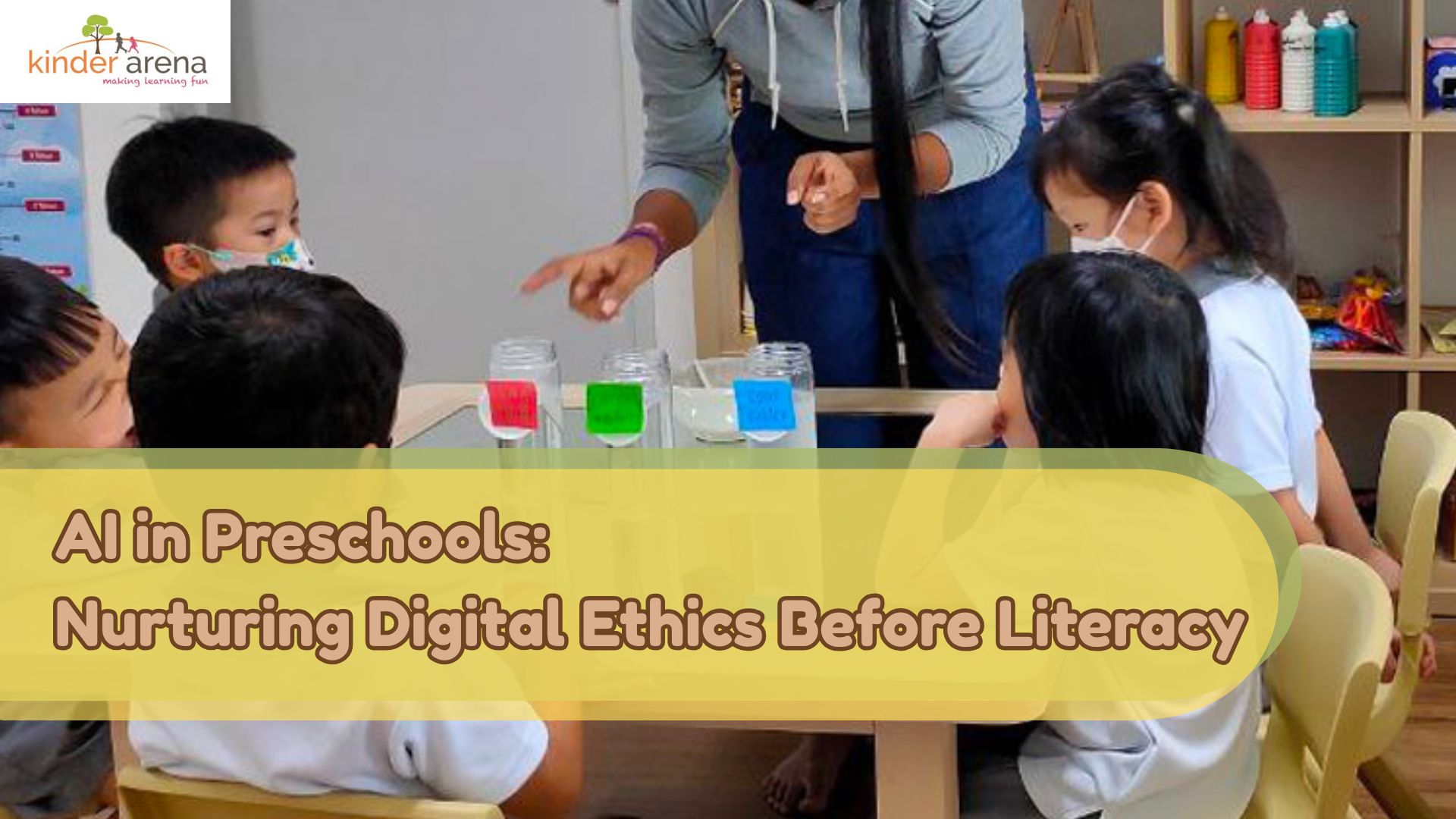
Inquiry-based learning teaches children to look at the world itself.
Instead of staring at a screen for answers, they are encouraged to ask:
- Why did this sink?
- Why did that plant grow faster?
- What happens if I mix these colours?
- Why did the tower collapse?
These are early forms of science, logic, and critical thinking.
Read more: A Day in a Life of a Kindergarten: What Kids Actually Learn
Outdoor Inquiry vs. the Digital Haze
In cities like Kuala Lumpur and Penang, many children already spend a large part of their day indoors and around screens.
That makes the preschool environment even more important.
A strong screen-free preschool gives children space to:
- Move freely
- Explore outdoors
- Interact with natural materials
- Build physical confidence
- Engage with people, not just devices
More importantly, excessive screen time will affect vision health.
“Experts have warned that childhood vision problems are rising, especially in urban areas. One Malaysian clinical paediatric optometrist reported that based on local screenings, about one-third of preschoolers aged 5–6 were unable to see clearly in class.” – The Star, Too many kids with eye problems
The Solution: Positioning the school as a physical sanctuary. Instead of “Artificial Intelligence,” focus on “Natural Intelligence.”
How Does a Screen-Free Preschool Prepare Children for a World of AI?
The Future Belongs to Better Question-Askers
AI is only useful when the person using it knows how to ask the right question.
That is why inquiry-based learning matters so much.
It helps children develop habits such as:
- Asking why
- Noticing patterns
- Spotting what is missing
- Testing possibilities
- Refining their thinking
These are the same mental habits behind strong problem-framing and future AI literacy.
Human-Only Strengths Will Matter More
As AI grows more capable, human strengths become more valuable.
These include:
- Empathy
- Ethics
- Creativity
- Judgment
- Collaboration
- Emotional intelligence
A screen-free preschool gives children daily chances to practise these qualities in real life.
Deep Focus Will Be a Superpower
In a world full of short videos, alerts, and constant scrolling, focus is becoming rare.
But focus is still essential for:
- Reading
- Problem-solving
- Language learning
- Listening
- Project work
- Complex thinking
When children spend time building, observing, drawing, sorting, and exploring one idea deeply, they are practising a skill that will matter for years.
How Screen-Free Learning Supports Year 1 Readiness
Many parents worry that a child may fall behind without early device use, but the biggest challenge in Primary 1 is usually not typing or tapping.
It is whether the child can:
- Sit and listen
- Follow instructions
- Stay focused
- Speak clearly
- Manage emotions
- Learn in a group
These skills are often far more important than early digital familiarity.
This aligns closely with the expectations set by Malaysia’s Ministry of Education Preschool curriculum KP2026, which places strong emphasis on character development (adab), social integration, and communication skills in early primary education.
Conclusion: Future-Proofing at Kinder Arena
Preparing children for a world shaped by AI does not mean giving them screens earlier and earlier. It means strengthening the human qualities technology cannot replace, such as curiosity, focus, resilience, empathy, and independent thinking.
At Kinder Arena, we focus on inquiry-based, hands-on, screen-free education because we believe this gives children the strongest start for the future.
How We Apply Inquiry-Based Learning Daily
- Teachers guide, not just instruct
- Questions are encouraged before answers are given
- Activities are designed to allow trial and error
- Children are observed and supported individually
- Learning happens through interaction, not passive delivery
By building human skills first, we help children grow into confident learners who can one day use technology wisely, not depend on it too soon.
Reach out to us to find out how we support your child’s development.
“When machines do the thinking too early, children may never learn how to think deeply for themselves.”
Source:
- The Star (Malaysia) — “Too many kids with eye problems” — Aug 26, 2025.
- World Health Organization (WHO) — Guidelines on physical activity, sedentary behaviour and sleep for children under 5 years of age — 2019 (PDF).
- NCBI Bookshelf (WHO guideline summary / excerpted text) — Executive Summary: WHO Guidelines… — 2019.
- Zeißig et al. — “The association between boredom and creativity in educational contexts: A scoping review…” — Apr 6, 2024.
- Muppalla et al. — “Effects of Excessive Screen Time on Child Development” — 2023 (review; includes reward-pathway discussion).
- Armitage & Redshaw — “The nature and development of cognitive offloading in children” — Sept 26, 2024.
- Gerlich — “AI Tools in Society: Impacts on Cognitive Offloading and the Future of Critical Thinking” (Societies) — Jan 3, 2025.
- Malaysia Ministry of Education / KPM (Bahagian Pembangunan Kurikulum) — Prasekolah 2026 page (KP2026 downloads/index) — (live page; access date varies).
- Bernama — “Six Learning Areas Anchor New Preschool Curriculum, Says Fadhlina” — Jan 5, 2026.
- Guzmán-Muñoz et al. — “Physical Activity and Its Effects on Executive Functions in Children and Adolescents…”
Frequently Asked Questions About AI in Preschools
Will My Child Fall Behind If They Do Not Use Tech In Preschool?
Not necessarily. At preschool age, focus, language, motor skills, social confidence, and emotional regulation matter more than early device familiarity.
How Does Kinder Arena Teach Logic Without Computers?
Through puzzles, building tasks, sorting, pattern work, storytelling, experiments, and observation. These help children understand cause and effect in a real, concrete way.
What Is The Human Edge In Education?
The human edge includes empathy, ethical judgment, creativity, emotional intelligence, and social awareness. These are qualities that technology cannot fully replace.
How Do You Handle Digital Ethics If Children Are Screen-Free?
Digital ethics starts with human ethics. Children first need to understand kindness, honesty, respect, and boundaries through real relationships and guided interaction.
Is Inquiry-Based Learning Better For The Future?
It is highly relevant because it teaches children how to think, ask questions, solve problems, and explore uncertainty. These are essential skills in an AI-shaped world.
Can A Screen-Free Child Still Adapt To Technology Later?
Yes. Children with strong focus, confidence, and curiosity often adapt very well to new tools later because they approach technology more intentionally.