Phonics helps children understand how letters and sounds work together to form words, while whole language focuses on helping children understand meaning, build vocabulary, and enjoy reading.
Watching a child learn to read is one of the most exciting milestones of early childhood. Yet, parents quickly find themselves overwhelmed by the different reading methods being recommended.
- Should children learn through phonics?
- Is the whole language better?
- Or is there another approach altogether?
The truth is that most children benefit from both and in this guide, our preschool will compare phonics and whole language, explain the strengths of each approach, and help parents understand what to look for in a preschool reading programme.
At A Glance: Phonics Vs Whole Language
Feature | Phonics | Whole Language |
Primary focus | Connections between sounds and letters | Vocabulary, meaning and comprehension |
Teaching style | Explicit, structured and cumulative | Interactive and based on stories, conversation and meaningful experiences |
Helps children | Decode and spell unfamiliar words | Understand language, ideas and texts |
Common activities | Blending, segmenting and practising letter–sound correspondences | Reading aloud, storytelling, discussion, songs and play |
Role in an effective programme | Provides a reliable foundation for word reading | Develops the knowledge and language needed for comprehension |
These are not competing goals. A strong early-literacy programme teaches children how written words work while giving them plenty of opportunities to hear, use and enjoy language.
What Does Phonics Actually Teach Children?
Phonics teaches children to connect the sounds they hear in spoken language with the letters or letter combinations they see on a page.
For example, a child may learn that the letter m represents the sound heard at the beginning of “moon”. The child can then learn to blend the sounds in m-a-p to read the word “map”.
Phonics lessons commonly develop several skills:
- Recognising relationships between letters and sounds
- Hearing individual sounds within spoken words
- Blending sounds together to read words
- Separating words into sounds for spelling
- Decoding words that children have not seen before
- Building independence when reading simple texts
Systematic phonics follows a planned sequence. Children begin with simpler sound patterns before progressing to combinations such as “sh”, “ch”, “ee” and “ai”.
What Does Whole Language Teach Children?
Whole language is an educational philosophy that emphasises complete stories, meaningful communication and authentic reading experiences. These activities are associated with it include reading aloud, discussing stories and introducing new vocabulary.
However, these activities do not need to replace phonics.
Teachers may read a picture book aloud, discuss its characters, introduce new vocabulary and ask children what they think might happen next. As such, children benefit from:
- Vocabulary development
- Listening and speaking
- Story comprehension
- Understanding context and meaning
- Familiarity with books and print
- Positive attitudes towards reading
- Confidence in discussing ideas
“An international study shows that children who read one picture book a day may hear nearly 300,000 more words by age five than children who are rarely read to. This additional exposure can help strengthen vocabulary, comprehension and readiness for learning to read.”
Why Is The Phonics Vs Whole Language Debate Often Misunderstood?
The phonics vs whole language debate is often presented as a choice between two extremes: repetitive sound drills or enjoyable storytelling.
But really, children need both.
Phonics helps a child work out what a written word says. Language comprehension helps them understand what the word, sentence or story means.
For example, a child may listen to a complex story and explain it clearly but still struggle to read simple words independently, while another child may read every word correctly but find it difficult to explain what the story was about.
Neither skill is enough on its own. Strong reading develops when children can both:
- Decode words accurately
- Understand the language they are reading
The Education Endowment Foundation describes these as two closely connected parts of reading: word reading and language comprehension. This is why phonics should be taught alongside conversation, vocabulary building, storytelling and comprehension activities.
This has become increasingly important in our country.
“According to national data, 42% of local primary students in Malaysia are struggling to read effectively by age 11 or Standard 5, highlighting the importance of language learning as early as kindergarten.” – World Bank Report
Why Do Modern Preschools Combine Both Approaches?
Modern preschools do not treat phonics and language learning as separate activities. Instead, they combine phonics lessons with stories, conversations, songs and play.
This is often described as a balanced literacy approach. However, “balanced” does not mean giving equal time to two competing methods.
For example, a teacher may introduce the “b” sound during a short phonics lesson. Children might practise words such as “ball”, “book” and “bus”. Later, the teacher may read a story about a child taking a bus to visit a family member, giving children a chance to hear the same sound within a meaningful story.
In a Malaysian preschool, literacy activities may also reflect the languages and experiences children encounter every day. Teachers might:
- Sing English rhymes to practise letter sounds
- Use Bahasa Melayu songs to build rhythm and vocabulary
- Read simple Mandarin picture books during group time
- Discuss familiar experiences such as visiting a pasar malam, taking the LRT or preparing food with family
- Encourage children to describe pictures, retell stories or act out everyday situations
These activities help children connect written words with people, objects and experiences.
How Does Reading Development Work In Preschool Years?
Reading development begins long before a child can recognise written words or read a sentence independently.
During the preschool years, children build early literacy through everyday activities such as listening to stories, joining conversations, and singing songs.
Or more commonly, children asking questions about the world around them.
Important early literacy skills include:
- Listening and speaking, which help children understand sentences and express their own ideas
- Vocabulary development, which gives children the words they need to understand stories and conversations
- Print awareness, including knowing that written words carry meaning and that books are read in a particular direction
- Phonological awareness, which helps children hear rhymes, syllables and individual sounds within spoken words
- Early reading and writing attempts, such as recognising familiar letters, pretending to read or writing their own name
A child who points to the word “keluar” on a sign, recognises the first letter of their name or joins in with a familiar English or Bahasa Melayu rhyme is already developing literacy skills.
One simple way to understand this process is through the Reading House framework.
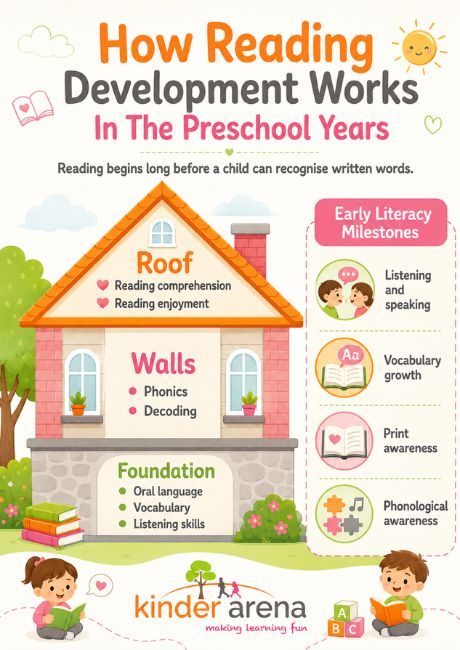
A strong reader needs every part of the house. Phonics helps children read the words, while language, vocabulary and experience help them understand and enjoy what they are reading.
Does Learning Multiple Languages Affect Reading Development?
Learning multiple languages does not slow down a child’s reading development. Malaysian children grow up in bilingual or trilingual environments, often learning English, Bahasa Melayu and Mandarin at the same time.
Children may progress at different speeds in each language depending on how often they hear, speak and read it.
For example, a child may speak English confidently at preschool, use Mandarin with grandparents and learn Bahasa Melayu through songs, books and classroom activities.
Parents sometimes worry when a child mixes languages or knows a word in one language but not another. In most cases, this is a normal part of multilingual learning rather than a sign of confusion.
What matters most is giving children regular, meaningful exposure through conversation, storytelling, songs and reading.
With time and practice, their confidence in each language can continue to grow!
“Malaysia has more than 1,800 Chinese and Tamil national-type primary schools, where pupils learn Mandarin or Tamil alongside Bahasa Melayu and English. Although there is no national figure for the exact number of bilingual or trilingual children, multilingual learning is already a normal part of education for a substantial number of Malaysian pupils.”
Read more: Parenting for Academic Success: Build Strong Learning Habits
How Can Parents Evaluate A Preschool’s Reading Programme?
The best preschool reading programmes develop more than letter recognition. They help children build phonics skills, vocabulary, comprehension, confidence and a genuine interest in books.
During a school visit, parents can ask:
- Is phonics taught through a clear and planned sequence?
- Are lessons short, explicit and appropriate for the children’s age?
- How often do teachers read stories aloud?
- Do children discuss stories and share their ideas?
- Are songs, rhymes, games and play included?
- How does the school support children who progress at different rates?
- Are children encouraged to sound out unfamiliar words rather than guess from pictures or context alone?
A strong programme should challenge children gently while keeping reading enjoyable, interactive and suited to their stage of development.
Supporting Balanced Literacy Development At Kinder Arena
At Kinder Arena, children learn language through our play-based and inquiry-based class that make reading, speaking and learning fun.
Our literacy development programme is supported through a balanced mix of early reading activities, storytelling, conversation and hands-on learning.
Just as importantly, children are given space to try, make mistakes and progress at a pace that suits their stage of development. This helps them build confidence alongside their reading and communication skills.
Discover how Kinder Arena helps children develop language, confidence and a love of learning through play-based education! Contact us and inquire now to learn more about our literacy programme and enrolment options.